
He Has Risen!
A Personal Reflection on the Eucharist and introspective forgiveness

Easter invites us into deeper contemplation of the rich symbolism embedded in the narrative of Christ’s crucifixion, resurrection, and ascension. The crucifixion at Golgotha “the place of the skull” (John 19:17) to me at least, symbolizes the surrender of worldly illusion, echoing the philosophical imperative expressed in Socrates' maxim to "know thyself." This moment is an invitation toward inner transformation, the relinquishing of ego-bound perceptions, and the willingness to descend into profound self-reflection.
In the Apostle’s Creed, we recite the affirmation of faith: "He suffered under Pontius Pilate, was crucified, died, and was buried; he descended into hell; on the third day, he rose again from the dead; he ascended into heaven and sits at the right hand of God the Father Almighty." Here, in symbolic language, the Creed describes an inner journey: the soul’s descent into darkness (ignorance), its spiritual awakening (resurrection), and finally, ascension toward a higher, divine state of understanding and union. Through our own faith, this journey becomes a personal trial, where by we refine our selves.
The account of Thomas, often called "the doubter," underscores the journey from skepticism toward spiritual insight. Thomas’s doubt “Unless I see the nail marks in his hands…and put my hand into his side, I will not believe” (John 20:25) symbolizes our soul’s struggle to transcend mere sensory experience and reason, to embrace deeper truths through personal revelation. Jesus’s humble response, inviting Thomas to touch his wounds, reminds me that true understanding arises from intimate, personal communion with the divine mystery, not only intellectual assent. One must be fully bought in to believe. Thomas's eventual exclamation, "My Lord and my God!" (John 20:28), shows a recognition of divine presence, reflecting the transformative power of our own authentic inner experience. It is a eureka moment.
The Ascension, described in Acts “After he said this, he was taken up before their very eyes, and a cloud hid him from their sight” (Acts 1:9) symbolically expresses the ultimate union of humanity with divinity through the willing son of God, Who walked as one of us. Philosophically, this mirrors Platonic themes of returning to the realm of forms or ideals, transcending physical existence into a realm of pure understanding and spiritual wholeness.
The Eucharist absolutely reinforces all of this symbolism. "This is my body... this is my blood of the covenant" (Matthew 26:26-28) the act of communion symbolizes our ongoing participation in the divine wisdom (the Logos), an inner nourishment guiding us continually toward spiritual maturity. Through this practice, we affirm our faith, we physically participate in something allegorical. It is a ritual affirming “Sophia’s Path”, the direct path to god. Through the divine feminine wisdom we come to understand understand the holy spirit. This completes the unity of the trinitarian experience. We experience God’s presence, God’s forgiveness of our imperfect nature, and our own mind through the Logos enriched.
To me, Easter, in its deeply symbolic nature, calls us not simply to reflect on the events from the past, but to actively engage in an inward spiritual journey. Through it we transcend doubt, we seek forgiveness from our selves and from our creator. We experience a genuine resurrection in consciousness, and ascend toward our divine source to invite the infinite mystery within.
Happy Easter to all of my Christian Friends and Brothers.
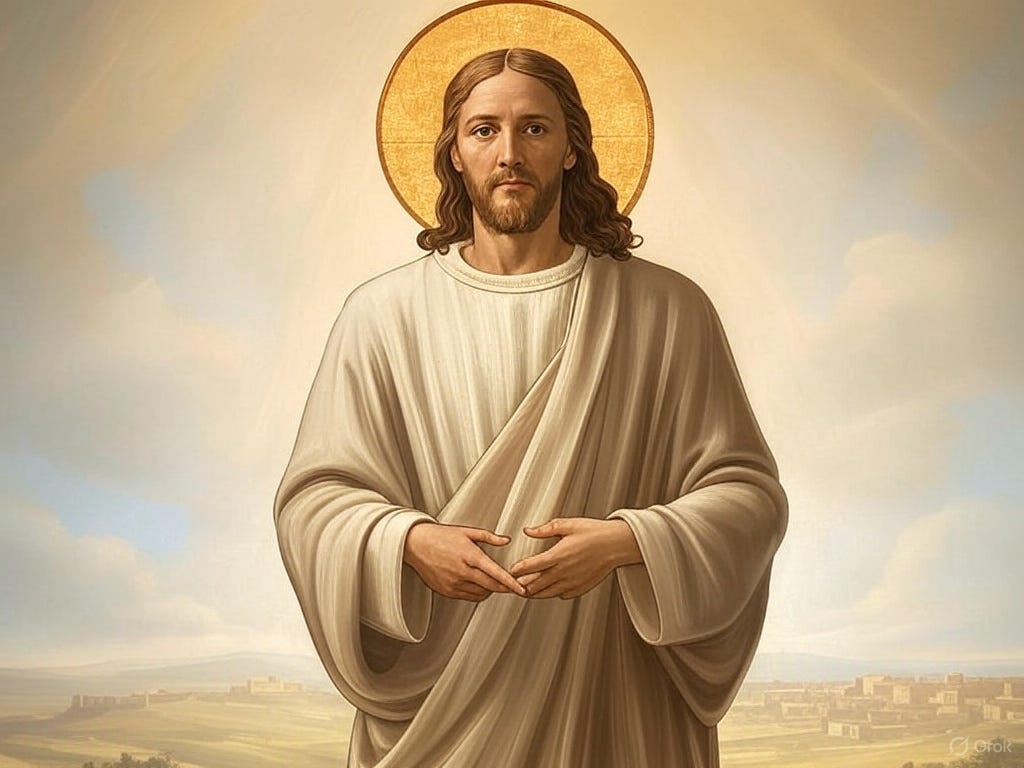
Picture created with GROK.