

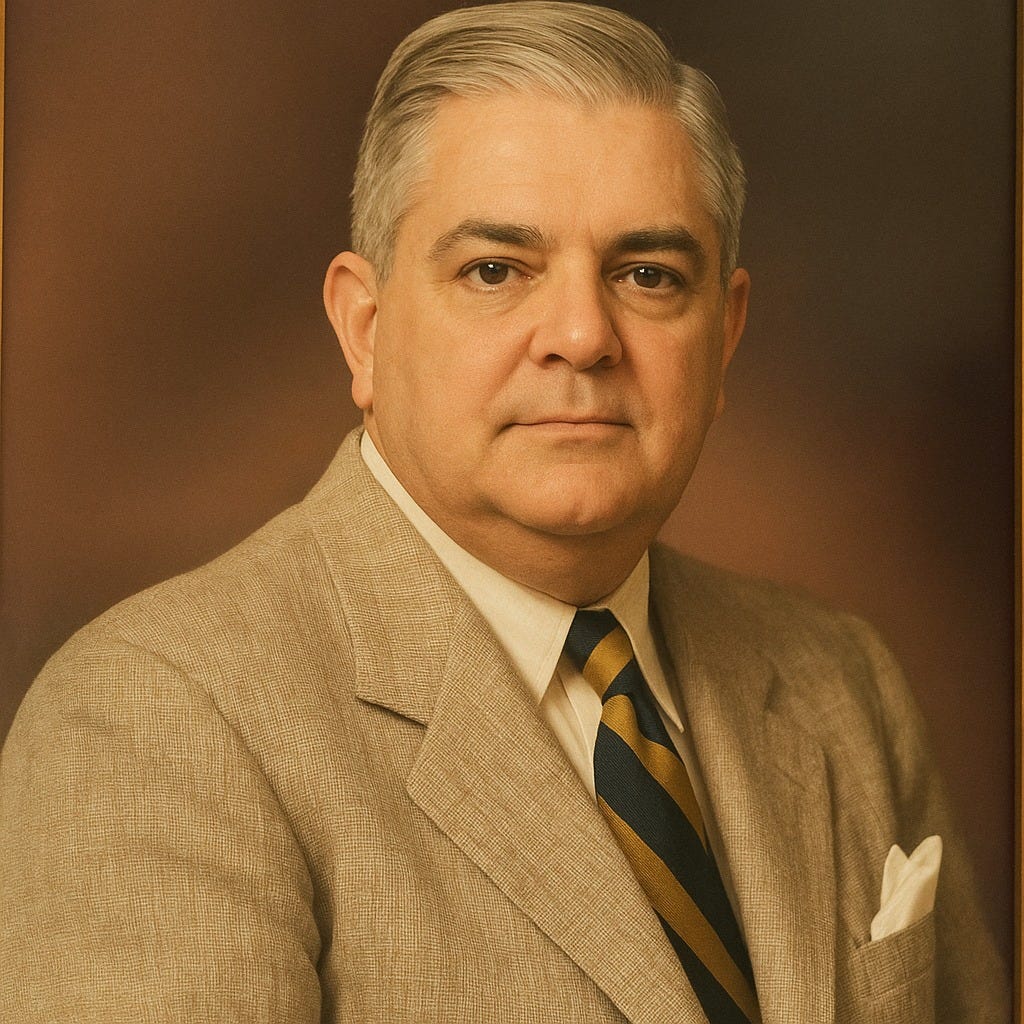
In the 1920s, a young man stepped into the antient halls of one of the world’s oldest fraternal orders, Freemasonry. What he found there was not just ritual or tradition, but a avenue for his deep love of history, philosophy, and personal growth. That man was J. Ray Shute Jr.
Shute would go on to become one of the most prolific and visionary Masonic minds since the days of Albert Pike and Albert Mackey. Like those giants before him, Shute did not just interpret the Craft, he shaped it. He gathered thinkers, preserved rites, and forged connections across continents. His work preserved ancient philosophies while breathing new life into Freemasonry during a time of great cultural momentum.
Over decades, he compiled books, traveled the world with fellow scholars, and helped introduce and formalize rites from abroad that are still practiced today. His influence lives on in the organizations, research bodies, and degree systems that continue to grow, quietly carrying forward his legacy.
And yet, in 1949, Shute stepped away from it all. He quietly withdrew from Freemasonry; he perused Politics and there found an outlet for his great energy. It was not until 1986, through the encouragement of another dedicated Brother, David Hargett, whom I have mentioned before, that Shute rejoined the Craft.
What follows is one of his most stirring contributions: an oration delivered to the Grand Lodge of North Carolina in 1948. It is passionate, unflinching, and deeply prophetic. As you read it, I hope you feel what I felt, the conviction, the challenge, and the call to purpose.
You can find the full text in the Annual Proceedings of the Grand Lodge of North Carolina, 1948, page 123. I have included it below for your reflection.
Enjoy the read, and may it inspire your own journey.
GRAND LODGE OF NORTH CAROLINA
ADDRESS OF THE GRAND ORATOR (Docket No. 16)
Most Worshipful Grand Master and Brethren:
Our modern system of purely speculative Freemasonry was, historically at least, a logical transition from an operative Craft, which had honorary (or speculative, as we now use the term) members, into an organization of non-operatives who used the framework of the Craft and built up a symbolism on the working tools, emblems, and traditions thereof.
From its very inception, the speculative Craft has been a social order, and until we Americans discarded—very unwisely—this custom, Lodges always met at the festive board. This splendid fellowship attracted the attention of normal men everywhere. This ancient custom still obtains universally, save only in America.
It is very doubtful if our original speculative Lodges had much to offer in the way of ritual, as we now know it. Just a simple ceremony of entering an apprentice, who after a symbolic period of apprenticeship, was voted upon, or passed, and became a Fellow of the Craft. That was about all there was to the ceremony of becoming a member of this social fellowship, which attracted so many outstanding men to its Lodges. Men then, and now, differ little in their interest in such social groups—witness our many civic, service, and dinner clubs, which sprang into existence here to fill the need for this fellowship after Freemasonry completely abandoned the field.
For some reason, which I cannot as yet understand, the idea of conferring degrees made its appearance in Freemasonry a few years after its speculative origin—circa 1725. Many reputable students attribute the idea of degrees, which were originally unknown in Freemasonry, to an early exposé of the fraternity. At any rate, the third decade of the seventeenth century saw Master’s Lodges make their appearance and soon the tri-gradal system of degrees became the order of the day. Later, a literal avalanche of degrees followed. Presumably, if these degrees were interesting, a flock of them would be more so!
The development of Masonic ritual is a field of research in itself and, naturally, time does not permit even a discussion of it here. However, in passing, we can say that in this field more Masons have devoted their interests than in any other. The impact of William Preston in England and Thomas Smith Webb in America on Masonic ritual was most important. To them, we owe a lasting debt of gratitude.
As new leaders arose in Freemasonry, more than often, their particular ideas of government found their way into organic laws, and their philosophies oftentimes sneaked into our liturgical procedure.
Simple lessons—educational in nature—were inserted by Preston, Webb, and others into the ritual. Prayers were borrowed from various religious sources at hand. A burial ceremony was picked up, well-nigh bodily, from the Anglican Church liturgy. Shakespeare furnished many passages, and so our ritual is a most democratic text.
With all of this ritualistic and legal development, there arose also a school of symbolists within the Craft. To them we credit the application of new interpretations to the old emblems and symbols of the Craft. Like the Bible, the ritual of Freemasonry admits of practically every possible interpretation and seems to offer solace, comfort, hope, and a challenge to every conceivable type of human being.
Unfortunately, with the passage of time, many of our lectures, symbolism, and laws have become definitely outmoded. They need changing to meet changed conditions in our times. If we are to attempt to impart true knowledge in our ritual, then that information must be true, modern, and properly presented. Lectures should be revised so as to become factual, and when we wander off into the fictional, we should so indicate. Our symbolic obligations, with their fictional penalties, should either be properly explained or completely rewritten. This is a day of realities!
For some unknown reason, no doubt influenced in part by early changes concerning a legally constituted operative Craft, which had use for stringent laws, we have developed a code of laws to govern Freemasonry that make almost impossible the proper functioning of a fraternity which from its inception was supposed to be a democratic group of brethren, associated together for mutual happiness and fellowship, practicing charity, and operating in the simplest manner possible. Today, we are so encompassed by laws, regulations, and restrictions that it will be, no doubt, only a matter of time until we will need to add a counseling attorney to our list of officers to interpret our corpus juris to us.
By becoming numerically strong, we have attracted the attention of the public to us. In this modern world of ours, this is dangerous because a critical eye is now leveled on all things. Old statements made as facts are weighed in the scales of truth. The level of reality is laid on all things by our present-day candidates and enemies alike. We are living in an age of reason, when intelligent men no longer accept anything—not even religion—without authenticating and supporting evidence. Faith has been relegated to the category of obsolete terms, and in its stead, Reason has been substituted. It is an age of inquiring and critical minds—proof is a watchword. Freemasonry can, if it will, meet the challenge of modern times and become in truth an organization of liberals, as it was two centuries ago, which furnished the leadership for communities and nations alike.
The day has long since passed when institutions can justify their existence or hope for continuity only on the record of their longevity. They must either demonstrate their ability to make a definite contribution to our civilization or begin fabricating their shrouds.
I believe in the traditions of Freemasonry. I am persuaded that it can be a vital, motivating force in the world today. I am constrained to believe that we will meet the challenge of these times. I do know this: There never was, in all of the history of Freemasonry, a more opportune time for our gentle, peace-loving, rational, and democratic fraternity to show to the world exactly where we stand and for what we stand. It is a time for decent men and decent societies of men to stand up and be counted!
This is no day for passiveness, for middle-of-the-road traveling, for inaction, for indecision, for moral neutrality. The walls of the retreats must come down. We must leave our tyled and hidden sanctuaries and come out into the daylight of our world, where real problems are to be solved, where real battles are to be fought, where real decisions are to be made. We can no longer isolate ourselves and live apart from the realities of life—we are a part of every single event that occurs, and every problem of our day should be of deep concern to us. If we, as an organization, make no united effort to help solve the burning issues of this generation, then, in my opinion, we have lost whatever right we might otherwise have had to perpetuate our fraternity. Survival, then—as we want it—is predicated on service to humanity!
The four freedoms enunciated in the Atlantic Charter, and on which two billion human beings are dependent for their very existence in the future, are not new to our Order. We have observed these landmarks for centuries. Our fault lies in the fact that we have not properly disseminated these virtues outside the tyled recesses of our Order. We have not championed the beauties of the good life outside of the Mystic Circle—in short, we have been selfish. We can no longer maintain our silence; we can no longer divorce ourselves from the world. We must constitute ourselves into a militant force. We can no longer be Keepers of the Sacred Fire—we must, like the runners of ancient Greece, carry the flame from Marathon to every part of the world. We must no longer be Guardians of the Truth—we must be Missionaries of Light and shed the true light into the darkest recesses of the world. In short, we must alter our modus operandi and become active, rather than passive. We must be positive rather than negative. We must abandon the old and accept the new dispensation.
By whatever means are indicated, we must alter our laws, ritual, and customs and become a force for good throughout the world. We must move forward on the ashes of past platitudes, theories, and fiction to the new order of realism, honesty, and actuality.
A sentence in the Bible answers for all time the reason for Israel’s decay: “Israel is a vine that produces fruit to her own good.” That, frankly, is the danger confronting Freemasonry and the world. Unless we accept our responsibilities to our fellow humans around us and honestly try diligently to do something about it, we face a future of scientific extermination!
There is little doubt in my mind concerning the future course of Freemasonry, if it is to take its proper place in the annals of history. We must, of necessity, be associated with and take an active part in all and every movement designed to promote the common good. In a world which is facing total annihilation, sooner or later, unless we can establish universal brotherhood, I know of no single organization better equipped—historically and physically—to take the lead than Freemasonry. What a challenge!
With our traditions, antiquity, philosophy, and an almost perfect approach to the religious and political problems, we should extend a helping hand, literally, to all parts of the world. The moral, social, educational, cultural, and humanitarian upbuilding of the world, our nation, and the communities where we have lodges is truly an obligation to a Brotherhood such as ours. We could truly help build one world, because political, religious, racial, and linguistic differences constitute no barrier to us—we have a universal language—we are liberals in every sense of that term. If we will but accept this momentous challenge, then new life would enter into the language of our admonition to the new candidate concerning his duty to God, his country, his neighbor, and himself!
God grant we shall not be blind to this golden opportunity to help bring about the dawn of the golden age. Whatever charge may be hurled against us by our enemies; in whatever future lies ahead, it is my ardent hope and sincere desire that it shall not be one of complacency or of self-sufficiency or of moral and social isolationism. Better were it that we tried heroically to combat the evils of our age and were completely annihilated in our gallant effort!
For More information on Shutes contribution to freemasonry see Chris Hodapp's Blog.
https://freemasonsfordummies.blogspot.com/2018/03/when-builders-built.html
Hi Robert. Ray was my grandfather. Thx for this great article. Todd